
Thanks for joining me!
Good company in a journey makes the way seem shorter. — Izaak Walton

Thanks for joining me!
Good company in a journey makes the way seem shorter. — Izaak Walton

The National Museum of the Philippines is a museum of the Filipino people. It houses the most important ethnographic, anthropological, archaeological and visual artistry of the Philippines from the prehistoric period to the modern times.
If you are visiting Manila, the capital city of the Philippines, the National Museum is a place you must not miss. If you live in Metro Manila, and you’re always passing through Padre Burgos Avenue and Rizal Park, I assume you have already toured the different galleries inside the National Museum.
But if in case you haven’t, here are 15 photos that will make you eager to visit the National Museum of the Philippines right now.
1. How could you miss this architectural beauty located in the heart of Manila?

The National Museum of the Philippines is located in Padre Burgos Avenue, Rizal Park, Ermita, Manila. It’s a few minutes walk from the LRT-1 United Nations Station. It’s open on Tuesdays-Sundays, 10:00 AM – 5:00 PM. Entrance fee is only P150 pesos for adults from Tuesday to Saturday, and it’s free on Sundays! So what are you waiting for?
2. Don’t you like to see the Manunggul Jar which was made before Christ was born?

The Manunggul jar is one of the most precious jar collections of the Philippines. It is a secondary burial vessel excavated from a Neolithic burial site in Manunggul cave of Lipuun, Palawan dating back from 890-710 B.C. If you’re familiar with the 1991 edition of 1,000 peso bill (the one with the Banaue Rice Terraces), you’ll remember those two prominent figures at the top handle of the jar.
3. How about looking face to face with these prehistoric artifacts?

The National Museum has a gallery called “The Origin (Pinagmulan)”. The gallery presents vital information about the Philippines and the Filipino people during the four periods of Philippine pre-history: Paleolithic, Neolithic, Metal, and Ceramic Age.
4. Have you heard about the treasures of San Diego?
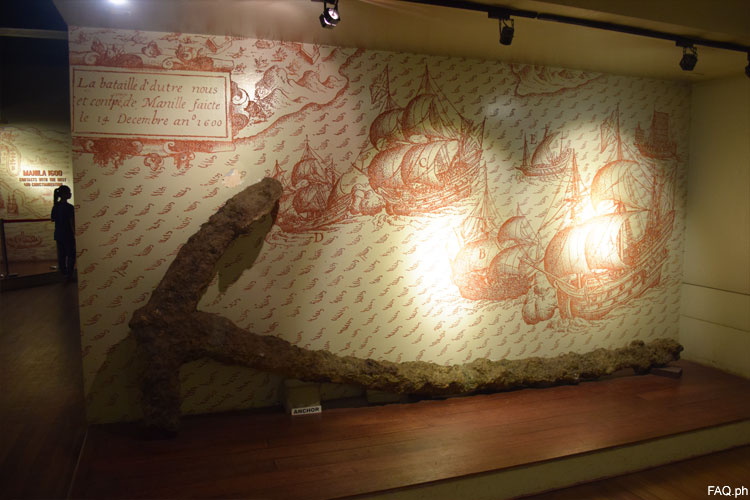
The anchor above is from the Galleon San Diego. The Spanish battleship sank just off Manila Bay when it clashed with the Dutch Ship Mauritius on December 14, 1600. When the shipwreck was discovered by French underwater archaeologist Franck Goddio in 1992, more than 34,000 artifacts and ecofacts were recovered from the site, including Chinese porcelains, Portuguese cannons, Japanese katanas and Mexican coins.
5. Why there were Japanese Katanas in the Spanish warship San Diego?

The artifacts above belonged to the Japanese mercenaries recruited by the Spaniards to supplement the fighting contingent on board the San Diego.
6. Travel back in time with this Balangay or Butuan boat.

This is a Butuan boat dated back to 1250 A.D. The boat is displayed at the Pinagmulan Gallery (The Origin), in the 2nd floor of the National Museum. It is the second boat recovered among the nine existing prehistoric boats in the Philippines. The first boat dated 320 A.D. is in the site museum in Libertad, Butuan. The Balangay or Butuan boat is an evidence of early Filipino craftsmanship and their seamanship skills during pre-colonial times.
7. Do you know these national cultural treasures?

Perhaps you are familiar with the figures above, as you might have seen them already in Philippine textbooks or postcards. In the picture from the right are the “Borak” (a mythical figure with the body of a horse and the head of a man), “Kokora” (a coconut grater used by the Maranao), and the famous “Kulintangan” (a musical instrument composed of a row of small, horizontally laid gongs).
8. Have you seen the works of master Filipino sculptor Isabelo L. Tampinco?

If Juan Luna is for painting, Isabelo L. Tampinco is for sculpture. Filipino sculptor Isabelo L. Tampinco (1850-1933), a contemporary of Jose Rizal, was known for developing the Estilo Tampinco style of carving and ornamentation. Most of his works were destroyed during World War II. However, you can still see some of his remaining works at the Fundacion Santiago Hall in the National Museum.
9. Here’s an altar piece from one of the oldest churches in Bohol.

The gallery I (Luis I. Ablaza Hall) of the National Museum features various religious arts from the 17th to 19th centuries, including a National Cultural Treasure, a retablo (altar piece) from the Church of San Nicolas de Tolentino in Dimiao, Bohol.
10. Who would not want to see the works of National Artist Guillermo E. Tolentino?

The works of National Artist Guillermo E. Tolentino, who dominated Filipino sculpture in the 1920s to 1970s, are displayed at Gallery XII (Security Bank Hall) in the National Museum. Tolentino was also the sculptor of the Bonifacio Monument in Caloocan City and the Oblation statue of the University of the Philippines.
11. Here are pencil and ink sketches drawn by the first National Artist of the Philippines.

Fernando C. Amorsolo (1892-1972) was the first National Artist of the Philippines. He was known for his oil paintings of rural life made in the classical style. The Gallery XI (SSPC Hall) displays the drawings of Amorsolo. It contains over 100 drawings made in a series of black-and-white pencil and ink sketches prior to making his final artwork.
12. You will surely love these cubist paintings by Vicente S. Manansala.

The Philippine-American General Life Insurance Company (Philam Life) commissioned Vicente S. Manansala in the 1960s to create seven large paintings for its building in U.N. Avenue, Ermita, Manila. This collection of amazing cubist paintings are now displayed at Gallery XXV (Philam Life Hall) in the National Museum of the Philippines.
13. Would you like to see more paintings and portrait busts of Jose Rizal?

At Gallery V of the National Museum is a homage to Dr. Jose Rizal, a Filipino National Hero, patriot, novelist and poet. The gallery honors Rizal, who was also a skilled artist. A visit to the gallery will give you an opportunity to see his drawing of the view of Gendarmenmarkt from his 1886 visit to Berlin, his sculptures Bust of Ricardo Carnicero, San Pablo Ermitano, Oyang Dapitana, and Mother’s Revenge, a declared National Cultural Treasure.
14. How about roaming around the old Senate Session Hall of the Philippines?
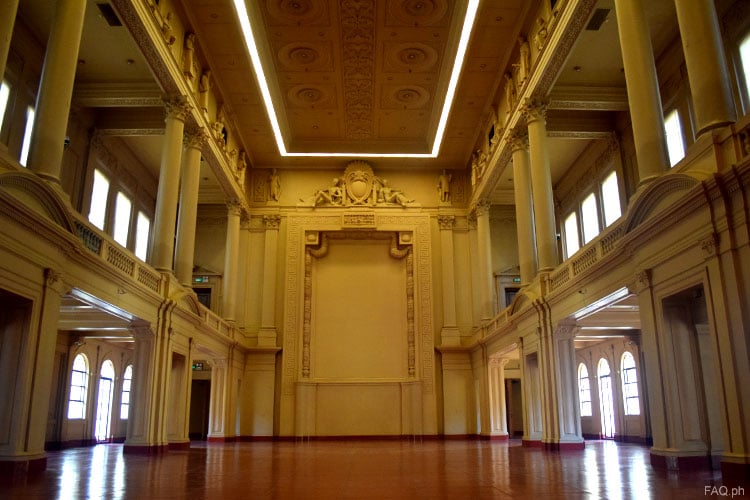
This Hall was originally designed by Architect Ralph Harrington Doane and Antonio Toledo in 1918 to be a library. However, architect Juan Arellano revised the original plans in order to convert the building to the seat of the legislature. The Second Regular Session of the 7th Philippine Legislature was formally opened during its inauguration on July 16, 1926 in the presence of Governor-General Leonard Wood, then Senate President Manuel L. Quezon, and House Speaker Manuel Roxas. You can also see more classical works of Filipino sculptor Isabelo Tampinco in the ornamentation and decoration of the Hall.
15. And of course, don’t you want to have a souvenir picture with the Spoliarium?

The Spoliarium by Juan Luna Y Novicio is one of the most famous and precious paintings in the Philippines. At 4.22 meters x 7.675 meters dimension, it is also the largest painting in the country. The painting was made by Luna in 1884 as an entry to the prestigious Exposicion de Bellas Artes (Madrid Art Exposition, May 1884) where it won the First Gold Medal. The painting is displayed across El Asesinato del Gobernador Bustamante (The Assassination of Governor Bustamante) painting by Félix Resurrección Hidalgo at the Old House of Representatives Session Hall in National Museum.
So what are you waiting for?
The National Museum is open Tuesdays to Sundays, from 10:00 AM to 5:00 PM. The admission is free every Sunday. Entrance Fees to the Museum are as follows:
Entrance Fees to the Museum of the Filipino People and National Art Gallery
(also includes visit to exhibits of the National Planetarium.)
For individual (in PHP):
Student: 50.00
Senior Citizen: 120.00
Adult: 150.00
For groups of 51 or more (in PHP)
Students: 40.00
Adult/Senior Citizen: 120.00
The entrance fees for the following are waived (with valid ID):
A. One faculty member for every group of 30 students
B. One tour coordinator per scheduled museum tour
C. Museum workers with I.D.s
D. National Museum staff and their immediate family
For inquiries call:
Museum Education Division
Telefax #: 527 0278
Email: education@nationalmuseum.gov.ph
Look for Lina/Tess

Luneta Park or simply Luneta, is a historical urban park in the Philippines. Located along Roxas Boulevard, Manila, adjacent to the old walled city of Intramuros, it is one of the largest urban parks in Asia. It has been a favorite leisure spot, and is frequented on Sundays and national holidays. Rizal Park is one of the major tourist attractions of Manila.
Situated by the Manila Bay, it is an important site in Philippine history. The execution of national hero José Rizal on December 30, 1896 fanned the flames of the 1896 Philippine Revolution against the Kingdom of Spain. The area was officially renamed Rizal Park in his honor, and the monument enshrining his remains serves as the park’s symbolic focal point. The Declaration of Philippine Independence from the United States was held here on July 4, 1946 as were later political rallies including those of Ferdinand Marcos and Corazon Aquino in 1986 that culminated in the EDSA Revolution. (https://en.wikipedia.org/wiki/Rizal_Park)

Rizal Park’s history began in 1820 when the Paseo de Luneta was completed just south of the walls of Manila on a marshy patch of land next to the beach during the Spanish rule. Prior to the park, the marshy land was the location of a small town called Nuevo Barrio (New Town or Bagumbayan in Tagalog language) that dates back to 1601. The town and its churches, being close to the walled city, were strategically used as cover by the British during their attack. The Spanish authorities anticipated the danger posed by the settlements that immediately surrounded Intramuros in terms of external attacks, yet Church officials advocated for these villages to remain. Because of the part they played during the British Invasion, they were cleared after the short rule of the British from 1762 to 1764. The church of Bagumbayan originally enshrined the Black Nazarene. Because of the order to destroy the village and its church, the image was transferred first to San Nicolas de Tolentino then to Quiapo Church. This has since been commemorated by the Traslación of the relic every January 9, which is more commonly known as the Feast of the Black Nazarene. This is why the processions of January 9 have begun there in the park beginning in 2007. After the clearing of the Bagumbayan settlement, the area later became known as Bagumbayan Field where the Cuartel la Luneta (Luneta Barracks), a Spanish Military Hospital (which was destroyed by one of the earthquakes of Manila), and a moat-surrounded outwork of the walled city of Manila, known as the Luneta (lunette) because of its crescent shape.
West of Bagumbayan Field was the Paseo de la Luneta (Plaza of the Lunette) named after the fortification, not because of the shape of the plaza which was a long 100-by-300-metre (330 ft × 980 ft) rectangle ended by two semicircles. It was also named Paseo de Alfonso XII (Plaza of Alfonso XII), after Alfonso XII, King of Spain during his reign from 1874 to 1885.Paseo de la Luneta was the center of social activity for the people of Manila in the early evening hours. This plaza was arranged with paths and lawns and surrounded by a wide driveway called “La Calzada” (The Road) where carriages circulate.
Tourist Spots that you shiould must visit!
Here are the places:

1. See for yourself the most famous monument in the Philippines.
The hundred year old Monument of Rizal is probably the country’s most famous, most visited and most photographed monument. It houses the remains of the Philippines’ most celebrated national hero, Dr. Jose Rizal. A visit to Rizal Park will give you the chance to honor Rizal and appreciate the national heritage he left to the Filipinos. Being there will also give you the better position to assess whether Torre de Manila should be demolished or not.

2.Visit the actual site where Dr. Jose Rizal was executed.
About a 100 meter distance from Rizal’s monument is the exact location of his execution on December 30, 1896. Life-size statues or dioramas depicting his final moments, including his execution by firing squad can be seen in the site which is named “Ang Pagpapakabayani ni Dr. Jose P. Rizal (The Martydom of Dr. Jose P. Rizal)”. An entrance fee of P20 for adults and P10 for students during day tour is charged to enter the site.

3.Behold the tallest flagpole in the country.
The 150 feet tall “The Independence Flagpole” is the tallest flagpole in the Philippines. It is located just in front of the Monument of Rizal.

4.Stand beside the starting point of all distances in the Philippines.
Just across the Independence Flagpole (going to Quirino Grandstand) is the marble marker Kilometer Zero (KM 0). It is the point of origin for measuring the distance to all provinces and cities in the Philippines.

5. Pay a tribute to the brave Filipinos in the Gallery of Heroes.
The Gallery of Heroes is composed of 2 rows of bust sculpture monuments of Filipino heroes from the different parts of the country, such as Juan Sumuroy of Samar, Aman Dangat of Batanes, Marcelo H. Del Pilar of Bulacan, Gregorio Aglipay of Ilocos Norte, and Sultan Kudarat of Cotabato. The 2 rows surround the Central Lagoon, where the Musical Dancing Fountain is installed.

6. Remember the martyrdom of GOMBURZA.
Before Rizal was executed in Luneta (Bagumbayan) in 1896, the place was already a famous site for executing Filipinos who resist against the Spanish government. The execution of Filipino priests Mariano Gomez, Jose Burgos, and Jacinto Zamora (popularly known as the GomBurZa) by garrote on February 17, 1872 was among the events that stirred the earliest Philippine revolution against the Spaniards. Jose Rizal has even dedicated his second novel, El Filibusterismo, to the memory of GOMBURZA. A marker of their actual execution site can be found just a few steps away from Rizal’s execution site.

7. Take a picture with this gigantic statue of Lapu-Lapu.
The forty-foot statue of Lapu-Lapu or the “Statue of the Sentinel of Freedom” erected at Teodoro F. Valencia Circle in Rizal Park was a gift by the Korean Freedom League to honor the memory of freedom-loving Filipinos who helped them during the Korean War in the early 1950s. Lapu-Lapu is best known as the hero of the Battle of Mactan (April 27, 1521) who stopped the invasion of Magellan in Cebu. He is considered as the first Filipino national hero who resisted the Spanish conquest.

8. Visualize the Philippine archipelago with this giant raised-relief map.
The Relief map of the Philippines is a giant raised-relief map of the country situated in the middle of a small man-made lake. The map includes the Scarborough Shoal, Kalayaan, and eastern part of Sabah. It is the first attraction that visitors will spot when they enter Rizal Park from Taft Avenue.

9. See stunning artworks from renowned Filipino artists.
The bronze sculpture above is the Seeds of Freedom (Binhi ng Kalayaan) by renowned Filipino sculptor Ed Castrillo. It was erected at the entrance of Binhi ng Kalayaan Garden which was named after it. The monument is dedicated to the unnamed Filipinos who fought for our freedom during the Spanish colonization. Underneath it is a time capsule buried which contains documents and memorabilia related to their great struggles. The sculpture is only one of the several amazing artworks you will find at Rizal Park.

10. Just relax and chill out at one of the largest urban parks in Asia.
Rizal Park is one of the largest urban parks in Asia. With its grassy land, green trees, gardens for picnics and meditations, as well as a musical dancing fountain, the park is also regarded as Manila’s green lung where people can escape the stressful noise and pollution of the city.
Bonus: Rizal Park is just a walk away to other important landmarks in the Philippines.

Rizal Park can be your starting point to other significant attractions in Manila, which include the National Museum of the Philippines (see picture above), the historic walled city of Intramuros, Manila Ocean Park, and the National Library of the Philippines. So a visit to the park will also give you an opportunity to visit those places which are not only important attractions in Manila but also in the country.
Continue reading “Everything about Rizal Park (Tourist Spots and History)”

Welcome to St. Augustine College-Las Piñas Campus. This is where you can see the facilities of SAC-LP Campus. The beauty of our school and why you should visit this personally.

First, this is the library of our school and it is located in second floor. In front of this is the faculty. It is available to the nursing student. But to us we need the teachers consent in able to have a access.

It is the hallway in the second floor, there is two rooms, one comfort room, and of course this where library and faculty is located; even the Registrar Office is in here.

This is the Registrar Office and our Registrar is Ms. Balili.

This is the hallway and it has one room for the Care Giver and the Management.
 Humanistabee